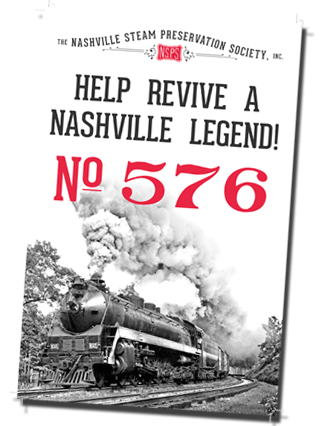
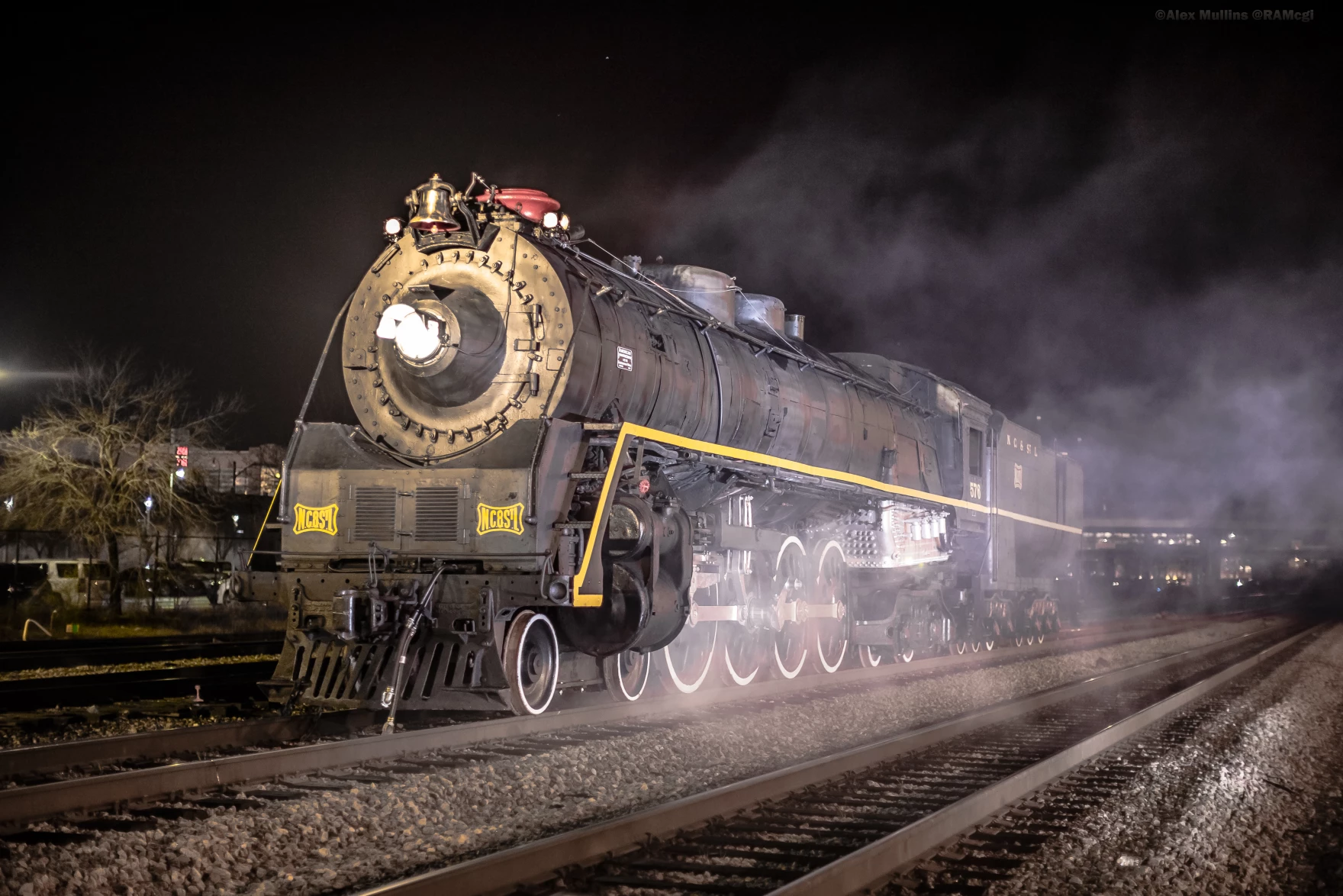
After chugging through a decade-long project, restoration of a steam locomotive that sat idle in Nashville’s Centennial Park for more than 60 years is nearing completion.
The clanging of train station bells is a sound engrained in Americana, serving as the musical score when long locomotives pulled into town. But at the Tennessee Central Railway Museum, they herald a different kind of arrival — the resurrection of a piece of steam history.
The Nashville Chattanooga and St. Louis 576 locomotive was built in 1942, just in time to serve a crucial role during World War II. It connected Nashville and Chattanooga to Atlanta, as well as Nashville with Memphis.
“It, along with her sisters, pulled special troop and supply trains all over the Southeast,” said Joey Bryan, vice president of the Nashville Steam Preservation Society. “It hauled people and supplies over a million miles throughout its 10-year service lifespan.”
After it was retired, the 576 found a new home in Centennial Park starting in 1953. In the more than six decades it occupied the space, it became an attraction for burgeoning and veteran ferroequinologists alike.
The locomotive also caught the eye of the entertainment industry, like the Life magazine cover in 1969 featuring Johnny Cash next to its wheels .
“It’s really incredible to think that thousands of people had a picture of 576 just sitting there on their coffee table alongside Johnny Cash,” Bryan said.
Nashville Steam has spent the past decade raising more than $4 million to breathe life back into the last-of-its-kind locomotive.
Bryan’s great-grandfather worked for the railroad, and he said he remembers crawling around on the 576 in the park as a child. His desire to restore it started in 2003 at an open house where he first sat in its cab.
“Sitting there on the engineer’s seat and my hand on the throttle, that was the first time I really envisioned what it could be,” he said. “And that idea never left my mind.”
In the middle of his answer, he paused to look over and smile at children pulling a train whistle. He said when people see a steam engine that isn’t operational, they’re only experiencing a fraction of its story.
“It’s really those sounds,” he said. “It’s the steam, it’s the temperature, it’s the rhythm of all the appliances that are working on it that really kind of dig into the mind and really opens up the interest and the passion for them.”
‘Voice of the locomotive’
To recreate the sonic magic of the 576’s whistle, Alex Mullins spent six months building it with video game software and a flight simulator throttle.
“Whenever you pull on the whistle, it changes the throttle position, which goes into the video game code and changes several variables to kind of add a little bit of steam hiss at the beginning, and then lead into the deeper tones as you really pull into the whistle,” said Mullins, a technical coordinator and photographer with Nashville Steam. “And I think it is the most accurate whistle simulator anyone’s ever made digitally.”